
PUBG's 2026 performance thrives on modern hardware, offering a vast graphical settings palette for competitive players to optimize framerates.
I descend once more into the familiar, frantic embrace of the battlegrounds, a digital phantom amidst the whispering pines of Erangel and the silent, snow-blanketed expanse of Vikendi. The year is 2026, and while the tides of gaming fashion have ebbed and flowed, PlayerUnknown's Battlegrounds remains a constant, a beating heart in the chest of competitive gaming. Over a million souls still seek that elusive chicken dinner daily, their journeys now painted across four distinct canvases. The game has shed its Early Access chrysalis; the once-constricting 144fps framerate cap is a distant memory, and the engine hums with a more refined, mature vitality. It feels like the perfect moment to pause, to reflect, and to chart the performance of this enduring world through the lens of modern hardware.
The game's technical soul, its graphical settings, are a tapestry of choices that weave together performance and visual splendor. PUBG presents a generous palette of options, a checklist of features that mostly satisfies. The support for various resolutions and aspect ratios is robust, with ultrawide displays offering a naturally wider field of view. An FOV slider exists, though it whispers its influence only to those who walk the earth in first-person. The specter of the framerate cap has been banished, a fix from years past. True modding support remains the one officially absent guest, though the shadows are never empty of unauthorized whispers. The developers vigilantly guard their realm against cheaters.
My journey to understand this world was made possible by a patron of performance, MSI, who provided an arsenal of hardware for this deep dive. From their quiet yet potent Gaming X graphics cards to a suite of powerful motherboards and laptops, it was the perfect toolkit to probe the game's heart across AMD and Nvidia landscapes.
At the core of the experience lies the global preset, the easiest dial to turn. But true mastery lies in finer adjustments. Let me paint the performance gradients for you:
-
Ultra to High: A ~30% surge in frames, like a sudden gust of wind.
-
Ultra to Medium: A 45-55% acceleration, the world responding more swiftly to your will.
-
Ultra to Low: A 65-75% boost, stripping away ornament for pure function.
-
Ultra to Very Low: Nearly double the performance, the world rendered in stark, competitive clarity.
Most warriors who live by the kill-feed operate in this stark realm of 'Very Low,' but with one crucial exception: View Distance set to Ultra. It is the scout's eye, keeping the horizon sharp while the immediate world is minimalist.
For those who wish to tune each string of the graphical instrument individually, I measured the resonance of each setting, using Ultra as the baseline chord and dropping each to its 'Very Low' note:
| Setting | Impact on Performance (Ultra -> Very Low) | Notes from the Field |
|---|---|---|
| Screen Scale | ~45% improvement at 70 | It's a subtle resolution shift; I prefer adjusting resolution directly. |
| Anti-Aliasing | Negligible | Unreal Engine's post-process AA is light. For quality, try Screen Scale at 120. |
| Post-Processing | 10-15% improvement | A blanket term for rendering polish; a meaningful gain to be had. |
| Shadows | 15-25% improvement | Affects ambient occlusion and depth. A significant frame liberator. |
| Textures | 3-5% improvement | A minor toll, provided your VRAM is sufficient. |
| Effects | Up to 25% improvement | The single most demanding setting. Explosions and particles are costly. |
| Foliage | ~1% improvement | Surprisingly gentle, despite forests and fields. |
| View Distance | ~3% improvement (CPU-bound) | Keep this high if your processor can bear it; it's more about CPU than GPU. |
| Motion Blur | ~3% cost if enabled | Off by default for a reason—clarity is king. A slight penalty if you crave the cinematic sweep. |
| Sharpen | No measurable impact | A free clarity boost, should you desire it. |
The path to competitive nirvana? Minimize Post-Processing, Shadows, Effects, and Motion Blur. This quartet, when silenced, can grant you a ~75% performance ascension, clearing the visual noise and making enemies less phantoms in the haze.
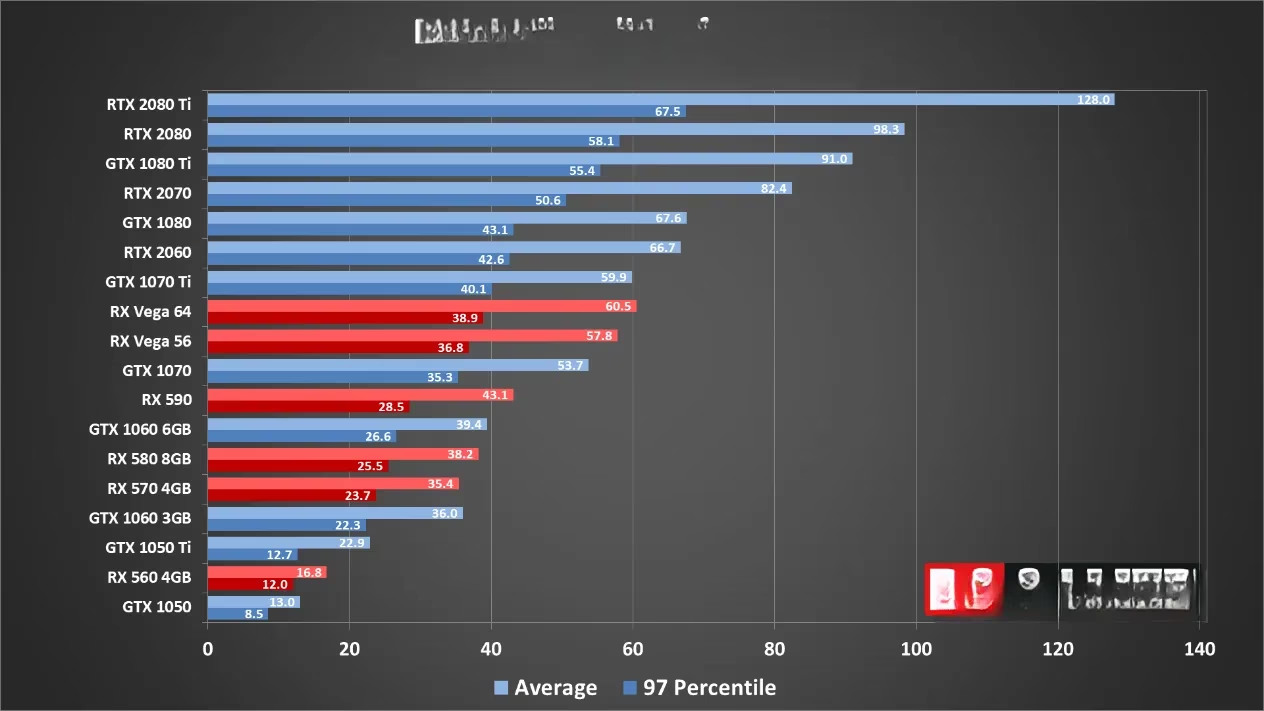
My testing grounds were built on an MSI Z370 Gaming Pro Carbon AC, armed with a Core i7-8700K and 16GB of swift DDR4 memory—a reliable companion for years. I ventured through resolutions and presets, from the spartan plains of 1080p Very Low to the demanding peaks of 4K Ultra.
-
1080p Very Low (The Streamer's Realm): Here, the CPU is the governor, capping frames near 200fps. Budget GPUs like the GTX 1050 can reach 60fps, but integrated graphics still struggle, a reminder of the dedicated hardware's purpose.
-
1080p Ultra: The visual feast. Performance dips 35-40% from Medium. Cards like the GTX 1060 or RX 580 need careful tuning to hold 60fps, while the GTX 1070 and above soar comfortably. The RTX 2070 is needed to ensure minimums never dip below 60.
-
1440p Ultra: The strain increases. Only the GTX 1080 and above average 60fps, with the mighty RTX 2080 Ti standing alone in keeping minimums steadfastly above that line.
-
4K Ultra: The brutal frontier. Even in 2026, it remains a punishing test. Only the RTX 2080 Ti breaks the 60fps average, and even it stumbles. For any semblance of competitive play, 1440p is the wiser, swifter path.
The CPU's role is nuanced. With a powerhouse GPU like the RTX 2080, the fastest processor can be 40% quicker than the slowest at 1080p Low. This gap shrinks to 20% at 1080p Ultra and virtually vanishes at 1440p and beyond, where the GPU bears the full burden. Yet, for those who livestream their saga, a potent multi-core CPU remains a valuable ally beyond the game itself.
The laptop arena tells a tale of constrained power. The mobile CPUs of the tested generation sometimes struggled to feed the mobile GPUs at lower settings, creating a bottleneck. The desktop GTX 1060 could outpace even a laptop with a GTX 1080 in minimum framerates at 1080p Medium. At Ultra settings, the hierarchy stabilizes, but the lesson is clear: thermal and power limits shape the mobile experience. Newer 6-core mobile chips have likely narrowed this gap, but the raw clock speed of desktop counterparts still commands respect.

Thankfully, the art of benchmarking PUBG has grown less arcane. The replay feature is a godsend, allowing me to walk the exact same path—a tense looting run, a frantic firefight in Pochinki—for every GPU and CPU. While these replays dissolve with each major engine update, their temporary existence brings blessed consistency. Across the four maps—Erangel, Miramar, Sanhok, and Vikendi—performance is a close kin, a testament to Bluehole's tuning of the Unreal Engine. Certain areas may demand more, but the overall rhythm of the framerate is a consistent drumbeat.
As I stand here in 2026, looking back on years of updates, the performance landscape of PUBG feels settled, mature. The engine is well-optimized; massive future gains are unlikely. The game runs with grace on a wide spectrum of hardware. The dance between AMD and Nvidia is now a close waltz, not a one-sided sprint. You can find a playable experience on nearly any decent graphics card with thoughtful settings.
For the competitor, the formula remains elegantly simple: minimize almost everything, but let your view reach for the Ultra horizon. Or, for a slightly richer world that still sings with speed, turn down only Post-Processing, Shadows, and Effects. PUBG endures not just as a game, but as a finely calibrated instrument, responsive to the touch of those who know how to play it, both in strategy and in settings. The battlegrounds await, as visceral and demanding as ever.