
PlayerUnknown's Brendan Greene unveils Artemis, a revolutionary 3D internet metaverse, powered by advanced terrain generation and massive multiplayer worlds.
Well, folks, strap in because it’s 2026, and the guy who once convinced us all that parachuting onto an island to fight 99 other people was a brilliant idea is back at it. I'm talking about Brendan "PlayerUnknown" Greene, the mind behind PUBG. He's not here to sell us another last-man-standing shooter, oh no. He’s decided that the word "metaverse" has been thoroughly abused and dunked in mud, and he’s on a mission to wash it clean and build the real deal. His new baby? A project called Artemis. And let me tell you, his vision makes Zuckerberg’s Horizon Worlds look like a 1990s AOL chat room. He’s thinking 15 years ahead, building not just a game, but what he calls a "3D internet." Talk about aiming for the stars—or in this case, the moon goddess.
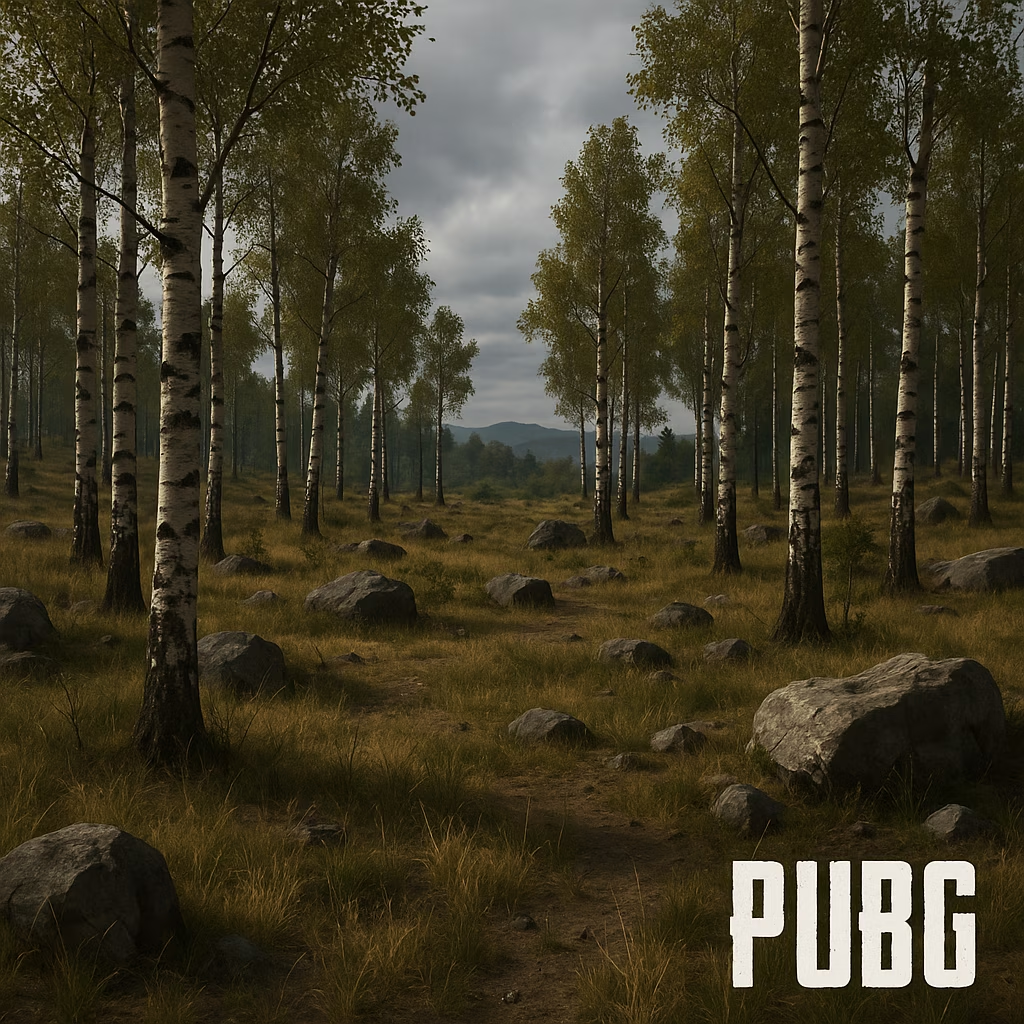
So, how do you build a whole new internet? You don’t just wake up one day and code it. You start with... a prologue. Greene’s studio, PlayerUnknown Productions, is cooking up a trilogy of games that are essentially massive tech demos for Artemis. Prologue, the first one, is already out in the wild in an early form called "Preface." It’s a survival game, but honestly, that’s just the cover story. The real star of the show here is the terrain generation tech, codenamed Melba. This isn't your grandma's random map generator. Melba is a machine-learning beast trained on NASA's real-world Earth terrain data. It can spit out entire, geologically realistic worlds at the press of a button—mountains, rivers, valleys, the whole shebang. Greene says there are 4.2 billion possible maps. I guess we’ll never run out of places to get lost and eaten by wolves. The artists are working with it daily, tweaking it, teaching it, making it sing. Prologue is the sandbox where they see if this world-building machine actually works before they go and build, you know, everything else.
Now, Game Two (still unnamed, come on Brendan, we need a cool codename!) is where things get seriously sci-fi. Once the terrain tech is solid, Greene wants to build a world that’s "earth scale"—500 million square kilometers. Let that sink in. The goal? To test cramming not thousands, but millions of players and AI characters into a single, shared space. He’s being coy about the details, but he mentioned something about "controlling an army." So, maybe imagine a strategy game on a planetary scale? All I know is my PC fan is already whimpering in anticipation. This game will be the stress test for the massive multiplayer simulation needed for Artemis.
Finally, we reach the promised land: Artemis. This is the endgame, the "3D internet." Greene’s philosophy is simple: the current so-called metaverses are just "IP bubbles." His vision is an open protocol, like HTTP for the web, but for 3D spaces. A world is a page. You could create your own world, mod it, share it, and link it to others. He compares it to a Star Trek Holodeck mixed with Minecraft. There will be a base game experience for everyone, but the real magic will be in user creation. He’s already seeing the seeds of this in his Discord community messing with Preface. "The internet was empty when it first started," he says. "This is probably going to be empty for the first few years, but then eventually you'll start to see the possibility." He’s betting on emergence, on creativity, on finding "the next PlayerUnknown" in the community.
Of course, building a new frontier comes with, well, frontier problems. I had to ask the tough questions. What about moderation in a world no one controls? What about the bad apples? Greene’s ideas are... interesting. He talks about decentralized identity—making it hard for trolls to just create new accounts—and consequences for actions. One proposed solution for troublemakers? Turn them into "ghosts." They can see and browse the world, but they can’t interact or communicate. Poof! Instant digital purgatory. He cites studies about how a tiny group of people often generates most online misinformation. Cut them off, he argues, and you solve a lot of problems holistically. As for illegal content? He admits that’s a puzzle they’ll have to solve with the community and within legal frameworks like the EU's AI regulations. "I want to build games with the community, rather than for them," he says. It’s a noble, if incredibly complex, ideal.
Then there are the tech hurdles. Platform? It has to be on everything. "Kids in Africa on their mobile phones have to be able to access it the same as gaming PCs on the West Coast," Greene insists. The experience might differ, but access is non-negotiable. NFTs and Blockchain? Ah, the million-dollar question. Greene sets the record straight: a 2022 interview led to headlines screaming "PUBG Guy Making Blockchain Game," which he says was a total misunderstanding. He called blockchain an "interesting financial instrument" but that’s it. Right now, he’s "not even thinking about it." Phew. The focus is on the core tech and making fun games first.
Let’s be real, the gaming industry in 2026 is still a rollercoaster of layoffs and funding droughts. Greene acknowledges the challenge. They got early funding for Prologue and have been careful, but they’ll need people to actually buy these games to fund the 15-year journey to Artemis. It’s a massive gamble. But Greene is undaunted. He draws a parallel to PUBG's humble beginnings. "Games are driven a lot by data points on Excel spreadsheets rather than making fun games and it's a little depressing," he laments. He wants Artemis to be a platform for pure creation, free from execs shooting down ideas.
So, here’s the roadmap:
-
Prologue (Now - 2025+): The terrain tech testbed. Survive, explore, and help shape Melba.
-
Game Two (TBA): The scale test. A planet-sized playground for millions of entities.
-
Artemis (2035-2040?): The 3D internet. Your canvas, your rules.
It’s a wild, ambitious, borderline-crazy vision. But as Greene puts it, he’s got a good team who "don't think it's that crazy." So, I guess we’ll see you in a decade or so, browsing 3D webpages and hopefully not getting griefed by digital ghosts. In the meantime, I’ll be in Prologue, probably still trying to figure out how to craft a decent shelter. Wish me luck!