
PUBG's custom match system evolved from a 2018 open beta into a thriving creator ecosystem, letting millions craft unique battle royale experiences.
A decade after PlayerUnknown’s Battlegrounds reshaped the battle royale landscape, its custom match system has quietly evolved into one of the most vibrant creator ecosystems in competitive gaming. What began as a tentative experiment in 2018 has blossomed into an intricate canvas where millions of players sculpt their own rules, transforming Erangel into everything from zombie-ridden labyrinths to high‑stakes esports arenas. The custom match feature, once capped at 10,000 concurrent games, now operates like a bustling metropolis of imagination—each lobby a distinct neighborhood with its own tempo, hazards, and legends.
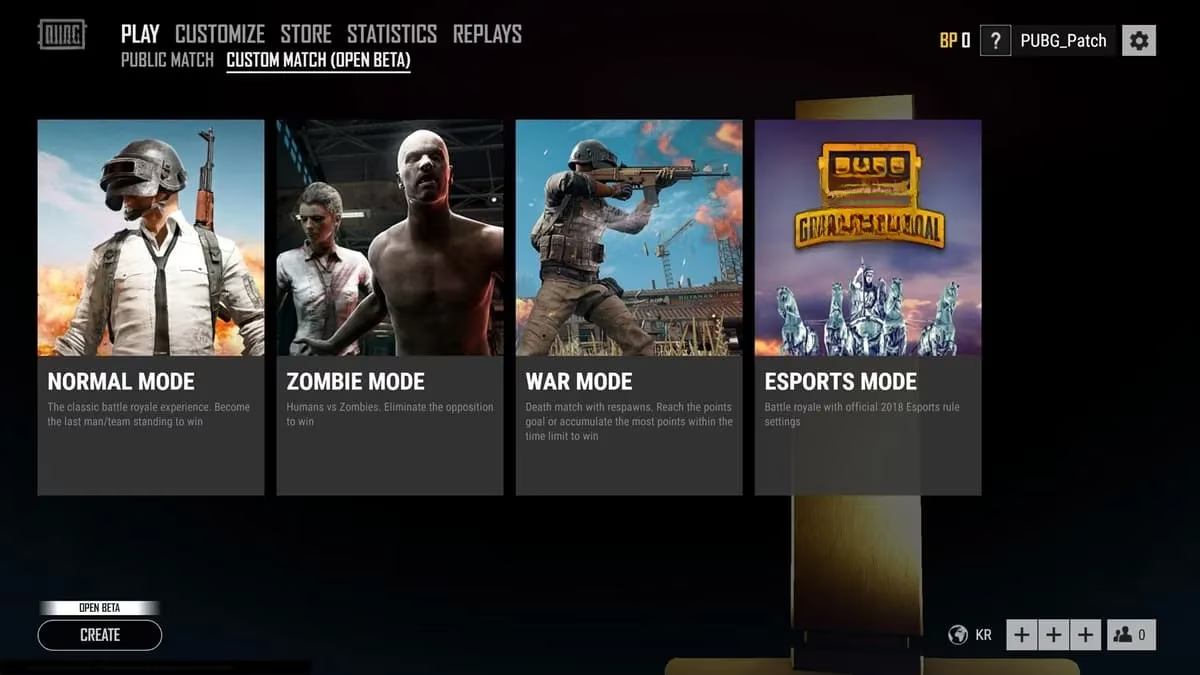
The roots of this creative revolution trace back to July 17, 2018, when Brendan “PLAYERUNKNOWN” Greene tweeted a message that crackled with modding nostalgia. “Coming from a modding background, I’m very excited that we can now give you all the means to experiment w/ game modes, fight hordes of zombies & play @PUBG in new ways with the Custom Games Open Beta!” Greene’s words were a tuning fork struck in a silent room, setting off vibrations that would shape the game’s destiny. The open beta, launched exclusively on test servers, introduced four foundational modes: Normal, Zombie, War, and Esports. Each could be twisted, pulled, and recalibrated like digital alchemists transmuting base metals into gold. Circle behavior, item spawn rates, vehicle availability, loadouts—every lever was handed to the community. Players could even craft private sanctuaries for friends or throw open the gates to the entire world, all without spending a single BP.
Yet this freedom came with a pressure valve. The 10,000 concurrent game limit hissed constantly with the steam of demand. PUBG Corp. was frank about the resource hunger; custom matches devoured server capacity like a ravenous beast, and the team warned that future monetization might be necessary to keep the system sustainable. During those early months, the test servers felt like a vast, dimly lit workshop where creators fumbled with unfamiliar tools. Lobbies took time to fill, UIs were rough, and balance was a suggestion rather than a guarantee. But the feedback loop was tight. Hawkinz, a community manager at the time, stressed that the beta’s true purpose was to discover how easy it was to find games, build lobbies, and iterate based on player insight. The community did not hesitate—forum threads bloated with ideas, complaints, and unexpected triumphs.
Fast‑forward to 2026, and the custom match system is unrecognizable from its fragile infancy. After a multi‑year journey through test servers, incremental UX overhauls, and a carefully managed migration to live servers around 2020, the modes have hardened into a cornerstone of PUBG’s identity. The 10,000‑game cap was gradually dismantled through a combination of cloud‑native scaling and a hybrid access model introduced in 2023—basic custom games remain free, while advanced features such as persistent lobbies, custom map variants, and priority queueing are bundled into a “Creator Pass.” This monetization pathway, once feared, instead acted like fertilizer on parched soil, funding infrastructure that now supports over 150,000 concurrent custom matches without a stutter. The four original modes have expanded into a taxonomy of sub‑genres: “Tactical War” removes respawn timers entirely, “Survival Zombie” twists infection dynamics with evolving mutations, and “Esports Pro” mirrors official tournament settings down to the last loot table nuance.
The creative output from the player base in 2026 is nothing short of a kinetic art form. Weekly featured lobbies curated by Krafton put a spotlight on off‑kilter inventions—imagine a 16‑vs‑16 mode where every player starts with a flare gun but only one plane passes overhead, or a zombie mode where the undead gain speed as the blue zone shrinks, turning the final circle into a whirlpool of panic. Some communities have built entire leagues inside the custom match framework, complete with their own leaderboards, dedicated referees, and live‑streamed seasons that rival official esports in production value. The “spectate password” feature, once just a bullet point in a patch note, now lets tournament organizers grant exclusive observer access to hundreds of casters simultaneously, turning grassroots competitions into broadcast spectacles.
What makes the 2026 iteration so compelling is the way it has dissolved the line between developer and player. Krafton actively harvests the most innovative mode designs and occasionally promotes them to permanent arcade rotations or limited‑time events—a feedback loop that turns the player base into an endless R&D department. For the creative minds behind the keyboard, the custom match suite has become a second language. Content creators host subscriber‑only survival challenges where the circle closes in fractal patterns; role‑play servers simulate entire survival narratives with complex rulesets; educational clans use adjustable bot modules to drill newcomers in recoil control and zone prediction. The tools first handed out in 2018 were a crude chisel; today they are a precision lathe.
Of course, the road to 2026 has not been without potholes. Server instability occasionally returns during peak windows when a viral mode sweeps across social media, and the specter of resource management still haunts Krafton’s engineers. However, the company’s decision to treat custom matches not as a cost center but as a living ecosystem has paid dividends. Player retention among custom‑match users is nearly 40% higher than that of quick‑join warriors, and the creator economy that has sprouted around the system—from map tutorials to clan sponsorships—has generated a secondary industry that feeds back into PUBG’s longevity.
As the battle royale genre continues to fragment across new titles in 2026, PUBG’s custom matches stand as proof that giving players a sandbox and a set of keys can be more enduring than any handcrafted update. What began as Greene’s nod to his modding roots has become a self‑sustaining galaxy of chaos and creativity. The question is no longer what the developers will add next, but what the community will dream up first—and that is a testament to a feature that started as an open beta footnote and grew into the beating heart of a perpetual battle royale.