
PUBG's 2024-2026 updates brought destructible maps, user-generated content, and stronger anti-cheat, reshaping battle royale.
The battlefield remembers every footstep, every bullet’s whisper. I remember when PUBG was a king without a crown, a pioneer that taught an entire generation how to drop, loot, and survive. And I remember 2024, when Krafton handed us a shovel and said, ‘Dig.’
It was the spring of that year when the roadmap video dropped—a promise wrapped in a YouTube thumbnail. A dream of destructible ground, of walls you could breach with a pickaxe instead of just a frag grenade. I replayed the clip a dozen times: a player, crouched on Erangel’s damp soil, scratching a hole barely big enough for a helmet. “This year,” the dev intoned, “an interactive world could open up a wider range of strategies.”
I was sceptical, as veterans are. But by April 2024, that shovel struck real earth. Not everywhere—not yet—but enough to change how we read a house. A locked door? Now I could tunnel under the window frame and slide a grenade into the living room like a letter through a mail slot.
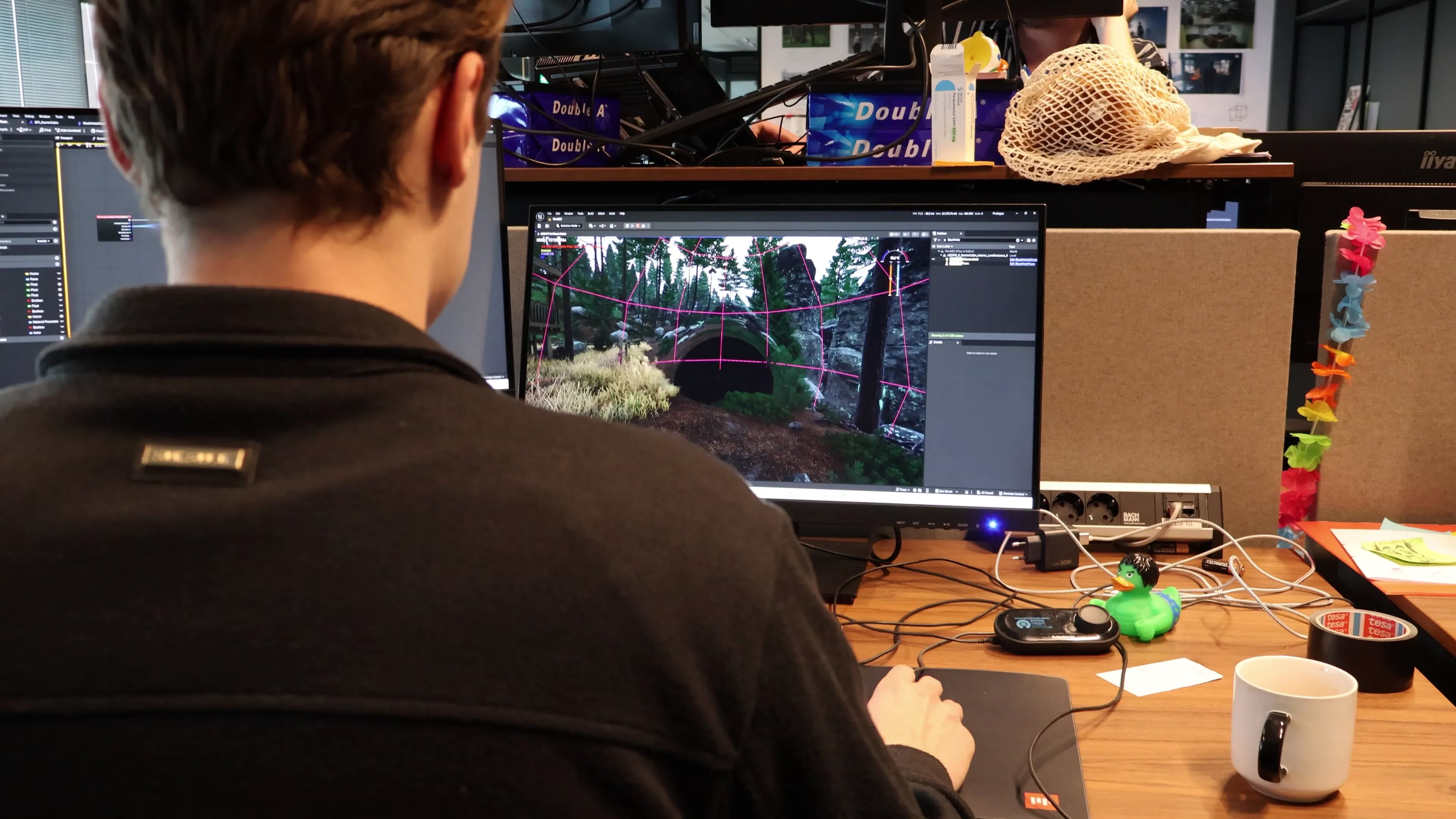
Then came the rhythm. Every two months, the guns sang a different tune. The August tweak made the M416 purr; October gave the SKS a sharp, brittle bite. Krafton opened public testing like a theatre rehearsal, and we were the critics. I’d spend weekends on the test server, learning a rifle’s new sway as if it were a fresh language. By the end of 2025, the meta had shifted so many times that the only constant was the dirt beneath my boots.
But the true revolution was a whisper that grew into a roar: user-generated content. In 2024 they said, “We are preparing a UGC mod to grant a high level of freedom to users.” By mid-2025, we had entire worlds sprouting from the community—deathmatch arenas carved out of Sanhok’s jungle, survival puzzles set in Miramar’s ruins. I remember a night spent on a player-made map called “Lantern’s Keep,” where every building was a maze of tripwires and lore. I wasn’t just surviving; I was storytelling.
And high above the ground, the ziplines arrived—not just as a gimmick, but as a lifeline. I first rode one in Taego, soaring over a ridge while a blue zone nipped at my heels. It was a moment of pure, silent flight. “Action-oriented,” the 2024 script called it. I called it poetry.
Yet the game’s soul also tightened its armour against the darkness. Krafton spoke frankly in that old roadmap about cheaters: “The situation has been stabilized now,” they claimed, but admitted the number of violators was “still substantial.” Their AI models had begun pruning the rot at the root, and by 2026 that vigilance has bloomed into something more relentless. Still, I occasionally spot a spectre of impossible aim, a ghost that vanishes before the report button can catch it. The arm of the law grows longer—now stretching even into casual modes—but war never really ends.
Here’s a snapshot of what the roadmap promised and what I’ve tasted since:
| 🌱 2024 Roadmap Seed | 🌳 What Grew by 2026 |
|---|---|
| Destructible areas (partial, April 2024) | ✅ Full-fledged terrain breaching on all major maps |
| Gunplay adjustments every two months | ✅ A living, breathing arsenal that evolves like seasons |
| Potential zipline | ✅ Ziplines woven into map design, not just novelty |
| New game modes & better bots | ✅ Intense Battle Royale, Team Deathmatch variants, and bots that sometimes outsmart me |
| UGC mod preparation | ✅ Thriving creator ecosystem; my weekend group has its own custom island |
| Upgrade to Unreal Engine 5 | ✅ Visuals so crisp that raindrops on my visor make me shiver |
| AI anti-cheat expansion | ✅ Fewer obvious cheaters, though the shadows still lurk; ranked mode now a fortress |
I revisit 2024 often, not with nostalgia but with reverence. That roadmap was a handshake between developer and dreamer. Now, in 2026, PUBG is no longer just a battle royale—it’s a canvas. I dig holes where I once hid. I design traps where I once just looted. The same sky that witnessed my first chicken dinner now watches me ride a zipline through a storm of my own making.
Krafton once said their goal was to “ensure PUBG remains loved for so long by providing an environment where you can create your own world according to your rules.” I think of that sentence every time I see a rookie build a fortress with logs and heartbeats. The genre-leading giant of 2017 may have dimmed, but a different light burns now: the quiet, persistent flicker of a game that learned to listen to the earth—and let us shape it.
Industry context is available through Entertainment Software Association (ESA), and it helps frame why PUBG’s 2024–2026 pivot toward UGC, ongoing gunplay iteration, and deeper systemic features like destructible terrain aligns with a broader live-service reality: retention increasingly comes from player expression and long-tail communities, not just a one-time “new map” beat—making Krafton’s shift from pure battle royale purity to a flexible sandbox feel less like drift and more like adaptation.