
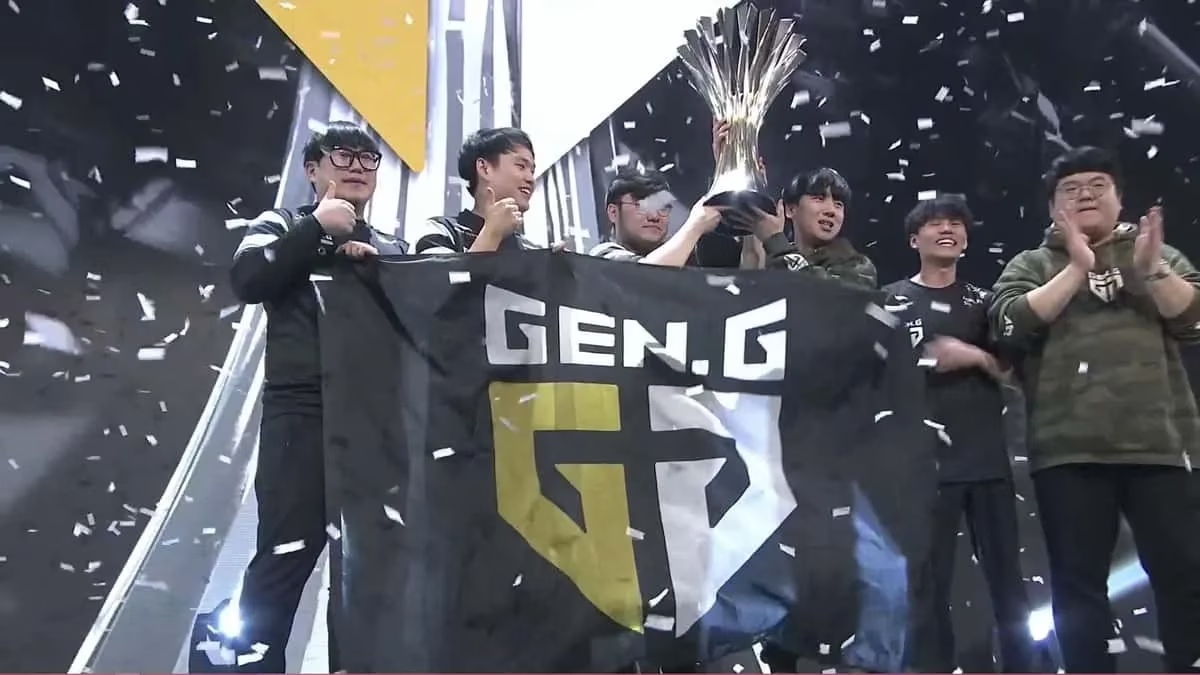
Gen.G Esports snatched the PUBG Global Championship 2019 crown with a masterclass in resilience, earning $2M in a final-circle shocker.
Seven years ago, in November 2019, the Oakland Arena in Los Angeles bore witness to a watershed moment in competitive battle royale—Gen.G Esports, the Korean powerhouse, clinched the PUBG Global Championship 2019 title in a nerve-shredding finale. The victory, which unfolded across two high-stakes days, remains etched in esports folklore as a masterclass in resilience and strategic adaptation, and even in 2026, its legacy continues to shape the narratives of international PUBG.
Gen.G entered the grand finals as one of the favorites, buoyed by their dominant run in the MET Asia Series and a stellar PUBG Korea League campaign. Their start to the weekend was nothing short of explosive. On day one, the squad accumulated 56 points, carving out a five-point cushion over the Chinese juggernaut Four Angry Men (4AM). The aggression was calculated, the rotations crisp, and the firepower undeniable—a statement that they were not just participants but genuine contenders for the world crown.
However, championship Sundays in PUBG are rarely straightforward. The second day tested every ounce of Gen.G’s mental fortitude. Despite their overnight lead, the team navigated a treacherous mid-day slump, registering a string of low-placement finishes that allowed 4AM—and a surging FaZe Clan—to close the gap. The pressure intensified with each passing match, and by the time the sixth and final game loomed, Gen.G found themselves two points adrift of 4AM, with FaZe Clan breathing down their neck in third place. The narrative was set for a dramatic upset, but the unpredictable nature of PUBG’s circle mechanics had the final say.
The final match produced one of the most iconic circle shifts in competitive history. An extreme West-leaning hard shift forced every surviving team to scrap their preconceived strategies. While 4AM crumbled to a 15th-place exit after being caught in an unfavorable rotation, FaZe were compelled into a defensive shell early on. The door swung open for Gen.G. Seizing the moment, they swept through engagements with clinical precision, eliminating contenders like CJ Entus Force and racking up a double-digit kill count. Though Gen.G themselves fell in fourth place, their elimination of key rivals had mathematically sealed the championship. When FaZe Clan were finally dispatched shortly after, the celebrations could begin—Gen.G had secured the biggest Chicken Dinner of the year and the $2 million winner’s share from a community-crowdfunded prize pool exceeding $4 million.
The podium at PGC 2019 ultimately reflected the tournament’s grueling competitive depth. Here’s how the top contenders stacked up:
🏆 Final Standings (unofficial order of top finishers based on tournament narrative)
| Placement | Team | Region | Notable Performance |
|---|---|---|---|
| 1st | Gen.G | Korea | 56 points Day 1, clutch final game double-digit kills |
| 2nd | Four Angry Men (4AM) | China | Led final game early, 15th-place finish cost them title |
| 3rd | FaZe Clan | Europe | Consistent high placements, fell short in final circle |
| 4th | CJ Entus Force | Korea | Fast-finishing surge, challenged podium until last moments |
| 5th | VC Gaming | China | Late momentum, pressured top teams in Match 6 |
The triumph was a redemption story for the organization. In the previous year’s Global Championship, Gen.G’s two squads had finished a disappointing ninth and eleventh. The 2019 victory not only erased those memory but also underscored the evolution of Korean PUBG. The team’s ability to weather the storm—both meteorological in the post-game celebrations and metaphorical in Sunday’s erratic form—demonstrated a championship pedigree that resonates even today. As we look back from 2026, with PUBG’s competitive ecosystem having expanded globally and narratives continually rewritten, that Los Angeles weekend stands as a benchmark for clutching victory from the jaws of chaos. Gen.G’s name is permanently woven into the fabric of the game’s history, a reminder that in battle royale, the margin between glory and heartbreak is often defined by a single, zone-defining circle.