
PUBG Mobile Club Open 2021 expanded mobile esports, boosting participation and viewership across new regions like Southeast Asia and Europe.
Picture it: 2021. The world was still shaking off the weirdness of the previous year, and mobile esports fans had something new to obsess over. PUBG Mobile Club Open (PMCO) suddenly decided it wasn't going to be a wallflower anymore. Organisers rolled out the red carpet into places that had never tasted a proper semi-pro battle royale circuit—the United Kingdom, France, UAE, Mexico, Nepal, Bangladesh, and a whole bunch of Southeast Asian heavyweights. It was like PMCO rocked up in a neon-lit helicopter and shouted, "Room for everyone, lads—let's dance!"
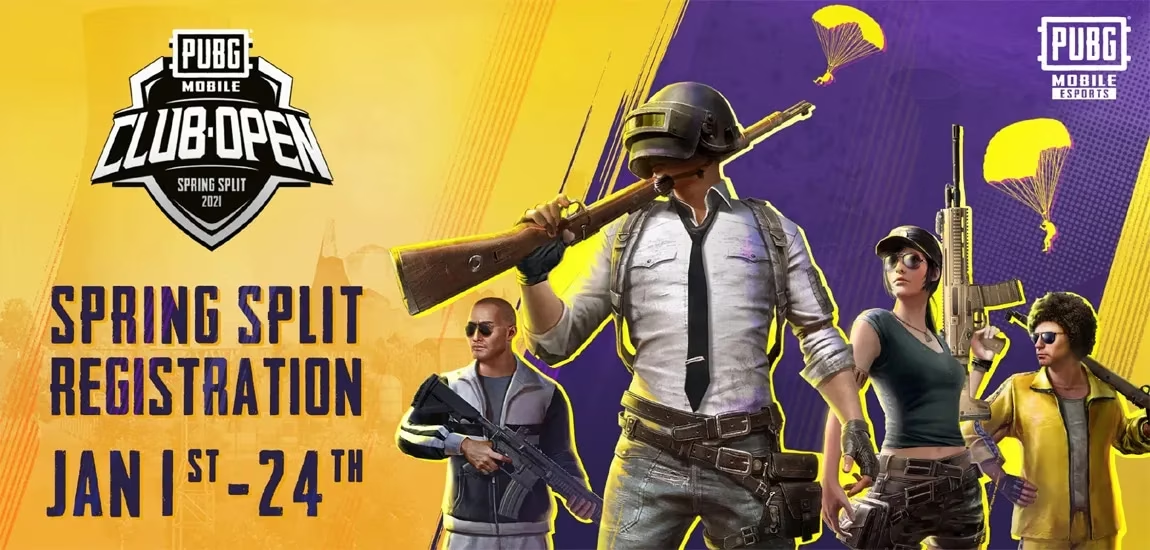
From January 1st to January 24th, the registration gates swung open across 27 regions. By the time the dust settled, 58,808 teams from 180 countries and regions had thrown their names into the hat. That’s a whopping 55% jump from 2020. If PMCO had a face, it would have been wearing an insufferably smug grin—and honestly, it deserved it. The competition had transformed into a ravenous beast, gobbling up hopeful squads like they were the last tin of loot in Pochinki.
But wait, let’s rewind a smidge. The 2020 esport programme had just wrapped up in January 2021 with the PUBG Mobile Global Championship (PMGC) Finals. That showdown wasn't just big—it was monstrous. Peak concurrent viewership hit 3.8 million, enough eyeballs to make a small planet jealous. NOVA-XQF snatched the crown and became the first-ever PMGC Champions, instantly turning into legends that aspiring PMCO rookies would print out and stick on their bedroom walls.
Now, think about what the PMCO actually represented. It was the entry gate to the PMGC, PUBG Mobile’s most prestigious tournament. The PMGC prize pool ballooned from $5 million to an eye-watering $14 million in that era. You bet your bottom dollar that every rookie with a smartphone suddenly started grinding like there was no tomorrow. The semi-pro scene officially stopped being the warm-up act—it became the main event’s launchpad.
The Spring Split of PMCO 2021 carved itself into history with region-specific showdowns. Southeast Asia kicked things off with a Group Stage from February 12–14, followed by Finals on February 19–21. South Asia, the Americas, the Middle East, and Europe took the baton next, running their Group Stages from February 16–21 and wrapping up Finals between February 25 and 28. The calendar looked like a deliciously chaotic buffet: every weekend a new region served up panic-fueled rotations, scuffed grenades, and the kind of zero-meter fights that make commentators lose their voices.
Here’s where the story gets deliciously meta. The expansion into Southeast Asia—Thailand, Vietnam, Indonesia, Malaysia and Singapore—wasn’t just a line on a press release. Previously, semi-pro teams in those regions had to wiggle through national championships like a secret handshake club. PMCO kicked the door down and said, “Nah, come in, show us what you’ve got.” Suddenly, the pipeline from amateur to pro had fewer locked gates and more open lanes. It’s no wonder PUBG Mobile esports saw more than 120,000 teams apply across 2020 alone—the hunger was real, and in 2021 it turned into a full-blown feeding frenzy.
Let’s sprinkle some numbers onto this spicy esports curry:
-
🚀 58,808 teams registered for PMCO 2021 globally
-
🌍 180 countries and regions represented
-
📈 55% increase in participation compared to 2020
-
🏆 $14 million total prize money announced for PUBG Mobile esports that year
-
📺 3.8 million peak concurrent viewers for PMGC Finals 2020
Now fast-forward to a lazy afternoon in 2026, and the echoes of that 2021 expansion still rattle through mobile esports halls. The UK—once a fresh-faced addition—now pumps out squads that regularly punch above their weight in the PMPL. The Middle East has become a terrifying hotbed of mechanical demons. Southeast Asia? Forget about it; the region’s fan base is so passionate that tournaments there might as well come with soundproof commentary booths.
The PMCO didn’t just grow; it evolved with the emotional maturity of a caffeinated squirrel on a sugar rush. Its purpose was to give players a “feel of competitive play” and pave paths to the highest levels. It did exactly that, and then some. By 2026, “I started in PMCO” has become a battle cry for pros who went from hiding in bathrooms on Miramar to signing contracts with tier-one orgs.
You can practically hear the older gen of players reminiscing: “Mate, I grinded that 2021 Spring Split with two hours of battery life and a prayer.” It’s a vibe that never gets old. The PMCO’s open-door philosophy turned esports from a gated mansion into a street carnival—loud, messy, and gloriously unpredictable.
One cheeky little detail that often gets buried: the 2021 Open was the first split to unify such a massive cross-section of the globe under one branding. In earlier years, you’d see fragmented cups and national leagues trying to hold the line. PMCO basically wagged its finger and said, “Enough of that, let’s get organised.” The result was a streamlined path: Club Open → Pro League → Global Championship. Simpler, deadlier, and far more fun to follow.
The prize pool inflation deserves another tip of the cap. When a mobile game announces $14 million in prizes, even the most cynical esports analysts raise an eyebrow. It wasn't just a flex; it was a statement that mobile esports had outgrown its “little sibling” phase. Players who once thought their only shot at glory was in PC titles suddenly found themselves in a legitimate career pipeline. All thanks to a semi-pro tournament that refused to stay small.
So where does PMCO live in 2026? It’s simultaneously a memory and a living organism. The 2021 landmark expansion set a precedent that newer tournaments still chase. Regional open competitions now operate on steroids—bigger prize splits, faster rotations, and meta shifts that can age a player by five years in a single season. The Club Open model proved that giving every region a seat at the table doesn’t dilute the esport; it electrifies it.
And yet, for all its size, the legacy of PMCO 2021 carries a whisper of that original brash energy: a feeling that anyone, absolutely anyone, could download the game, sign up with their mates, and suddenly find themselves staring down a path that leads to a global stage. In 2026, that’s not just nostalgia—it’s the beating heart of the scene.