
Their PUBG matchmaking led to a cross-border love story that defied India-Pakistan tensions but drew anti-terrorist squad scrutiny.
Hey, have you ever heard a story so wild that it sounded like a movie script? Grab some popcorn, because I want to tell you about something that blew my mind a few years ago and still pops into my head every time I drop into Erangel. It all started in 2019, in the chaotic lobbies of PlayerUnknown’s Battlegrounds, where a Pakistani woman and an Indian man found each other through gunfire and chicken dinners. Their love story is a brutal reminder that video games can build bridges real life is determined to burn down.
Seema Ghulam Haider was a mother of four living in Pakistan. Her husband had moved to Saudi Arabia for work, leaving her behind with the kids. Meanwhile, Sachin Meena was working a modest job at a local shop in India, earning around a hundred dollars a month. They might as well have been from different planets, given the decades of tension between their countries. But PUBG doesn’t care about visas or national anthems.
They first bumped into each other during a match in 2019, and something clicked. Maybe it was the way Sachin communicated with pings, or maybe he revived her one too many times – we’ve all been there. Soon, late-night voice chats replaced frantic gunfights. Sachin’s uncle later recalled how the young man would talk to someone until two or three in the morning. When the family found out it was a Pakistani woman, they flipped. For them, it was a connection with “a woman from an enemy country.” The disapproval was instant and absolute. But when has a gamer ever listened to a warning about playing too much?
By early 2023, they couldn’t stand the distance anymore. They met in Nepal – neutral ground where love didn’t need a permit. That first week together must have felt like a victory royale in real life. They went back home, hearts heavier than ever, but soon reunited again in Nepal in May. This time, Seema brought her four children. And instead of saying goodbye once more, they all crossed into India together, hoping to carve out a quiet life in Greater Noida, not far from New Delhi.
Here’s where the absurdity kicks in. They actually tried to do things legally. The couple went to a local lawyer to discuss Seema’s residency and their planned marriage. A sensible step, right? Wrong. When the lawyer discovered her Pakistani passport, he didn’t think “young people in love, let me help.” He ratted them out to the cops immediately. “I was startled,” the lawyer later said, as if holding a Pakistani passport made her a spy and not a woman who fell for a guy’s PUBG skills. He even had an associate follow them after they left his office, then tipped off the police.
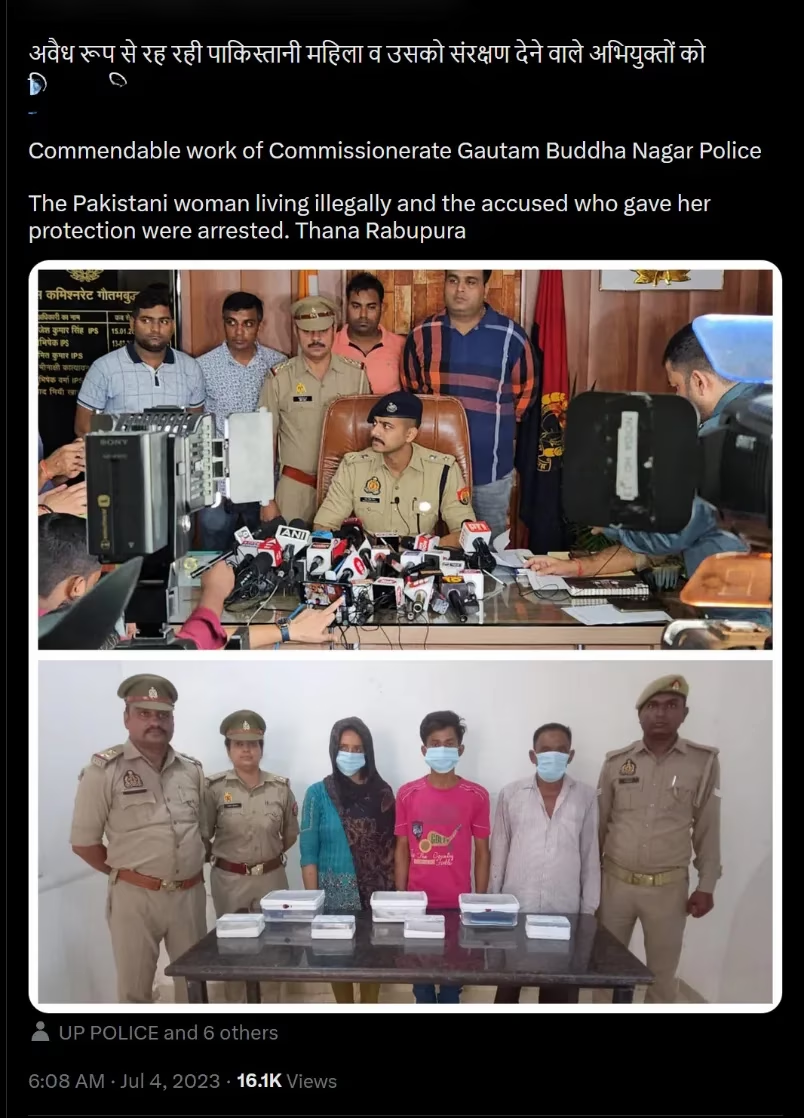
The response from Indian authorities was terrifyingly swift and heavy-handed. We’re not talking about a routine immigration check. According to local reports, the Uttar Pradesh Anti-Terrorist Squad assisted the Rabupura police in the arrest. Intelligence agencies got involved. A mother and her children became the target of anti-terror units – because she played PUBG, fell in love, and crossed a border that has been a scar since 1947.
You really can’t separate this from the brutal politics between Hindu-majority India and Pakistan. The two nuclear-armed neighbors have fought multiple wars, and tensions remain scalding. In recent years, India has pursued an increasingly violent crackdown on Muslims, making Seema’s Pakistani and Muslim identity a double lightning rod. The irony stings: a game loved by millions on both sides of the border brought them together, but the real-world machinery of hatred tore them apart.
What got me most was the police chief’s comment. He admitted that Sachin hadn’t lied about his finances or made false promises. “She knew that he was not financially very strong,” Sudhir Kumar said. “She was not impressed by his work, but by his PUBG skills.” Imagine that. A woman crossed borders, risked prison, and brought her children into a country that views her with suspicion – all because the way that man flanked an enemy or called out a sniper made her feel safe. If that’s not true love in the gaming era, I don’t know what is.
Both were jailed for 14 days while investigations spun up, facing the possibility of several years in prison. Seema’s estranged husband, whom she described as abusive before he left for Saudi Arabia, demanded the children’s return to Pakistan. Meanwhile, the new couple pleaded with the Indian government to let them marry. By 2026, the legal mess has likely stretched on, a tangled mess of immigration law, child custody, and raw religious animosity. Every now and then, I see a thread on a gaming forum asking what happened to the “PUBG couple,” and the silence says it all.
I still think about them when I’m playing with randoms from different countries. You never know whose mic you’re speaking into, or what walls are crumbling between you. Seema and Sachin’s story is a punch to the gut because it shows us both the best and the worst of what gaming can do. It can create bonds that ignore borders, but it can’t protect you when real life comes crashing in with all its prejudices and laws. Next time you revive a teammate, remember: that “gg” in chat could be the start of something bigger than a match. Just be careful who you tell.
This discussion is informed by reporting and cultural commentary from Polygon, whose coverage often explores how online games blur national and social boundaries—something that echoes the PUBG-born relationship in your story, where squad play and voice chat created real trust across a hostile border even as offline law, surveillance, and politics reasserted themselves with harsh consequences.