
PUBG Update 41.1 deploys a data-driven regional map rotation, with Erangel, Miramar, Taego, and Rondo each at 25%, optimizing queue health.
The ever-evolving world of PUBG: BATTLEGROUNDS receives yet another strategic refinement with Update 41.1, this time centered on how maps are selected across different regions. Rather than applying a rigid, one-size-fits-all map pool, the developers have harnessed a wealth of player behavior data to shape a rotation system that responds directly to regional tastes. The goal is simple but ambitious: to keep queues healthy, matchmaking fast, and the gameplay experience as satisfying as possible for everyone, from casual lone wolves to competitive squad leaders.
At the heart of this update lies a data-driven methodology. Player preference is not determined by a simple poll or a hunch. Instead, the team performs a comprehensive analysis that weighs multiple dimensions of map usage across all game modes. Playtime, match count, select rate, and even the frequency at which players voluntarily leave a lobby are all factored into the equation. By blending these signals, the system paints a remarkably accurate picture of which battlegrounds actually resonate with a region’s community and which ones provoke early exits. Due to rounding in the final presentation, the total of map preference percentages may sometimes appear slightly above or below the 100% mark, but this minor quirk in no way diminishes the reliability of the underlying insight.
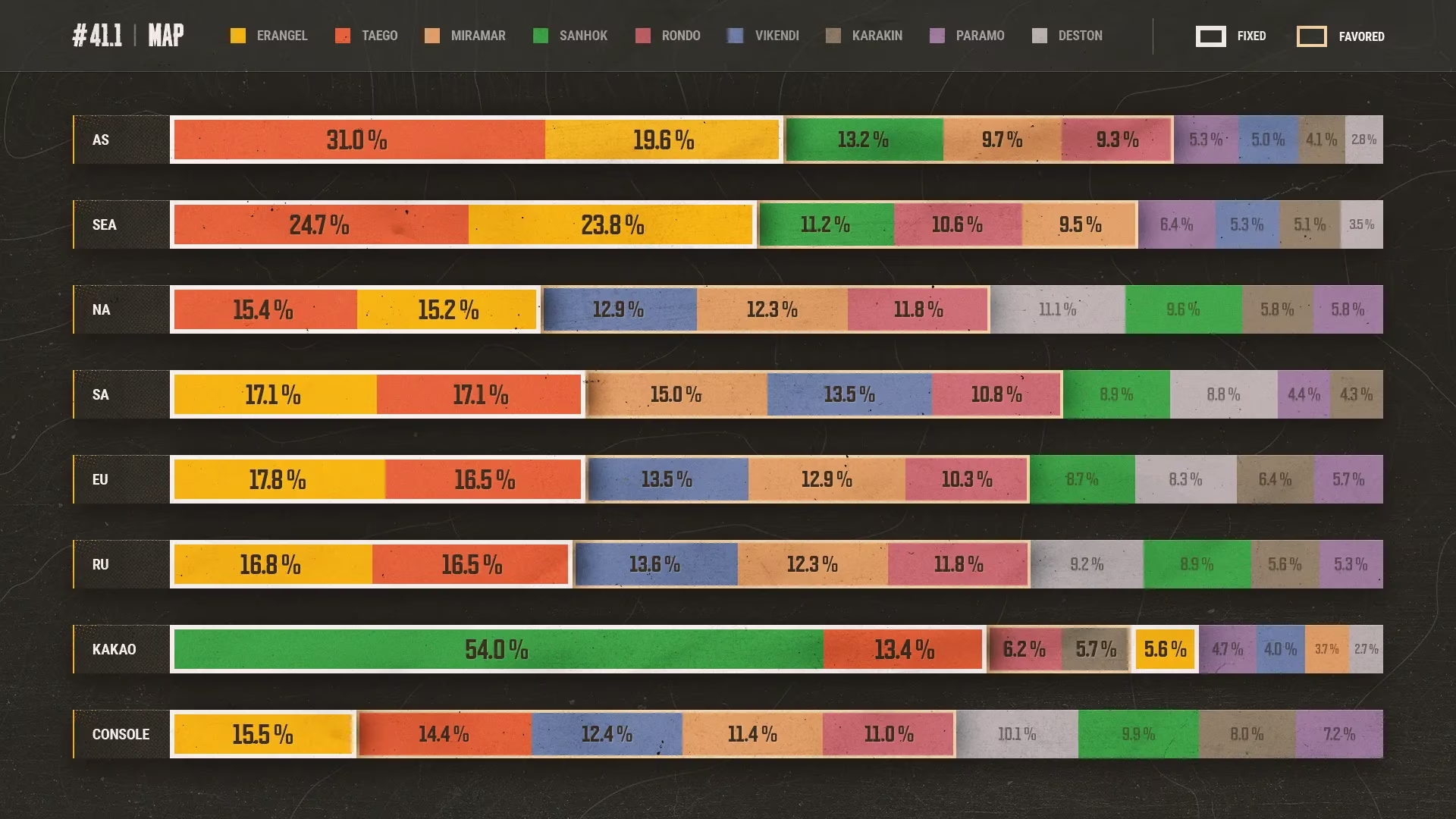
Looking at the infographic released alongside the announcement, one can’t help but marvel at how geography shapes virtual battleground cravings. Certain classic 8x8 km giants continue to enjoy universal reverence, while smaller, more intimate maps ebb and flow in popularity depending on the part of the world. The data serves as a mirror reflecting diverse playstyles: do fast-paced hot-drops dominate a region, or do players prefer the slow-burning tactical buildup of a long-range engagement? With this question constantly in the back of the design team’s mind, the resulting rotations feel less like a corporate decree and more like an organic answer to community sentiment.
Based on these regional map preferences, the following rotation will be activated in Update 41.1. The list itself sparks immediate curiosity. Why these specific four maps, and why at equal weight? Could it be that this quarter of iconic battlegrounds strikes the perfect balance between nostalgia, competitive integrity, and modern design? The answer likely lies in their collective ability to accommodate both aggressive in-your-face gunfights and the tension of scoped overwatch. The rotation for the affected queues features: Erangel (25%), Miramar (25%), Taego (25%), and Rondo (25%). It is a lineup that brings together the birthplace of the battle royale, a vast desert arena, a vibrant East Asian-inspired terrain, and a dynamically shifting urban-rural hybrid map introduced in more recent years. By giving each a quarter share, the system ensures that no single flavor dominates for too long, yet every drop still carries the high stakes that define PUBG.
Time zones and platform differences are handled with crisp clarity. PC players can mark their calendars for every Wednesday at 02:00 UTC, when the next rotation will take effect, keeping the map selection fresh midweek. Console players, on the other hand, see the change land every Thursday at 07:00 UTC, allowing a slightly staggered yet equally predictable cadence. This regularity is a blessing for squads that plan their gaming sessions around favorite maps. Who hasn’t felt the rush of joy when a beloved battleground rotates back in, or the mild groan when a less-preferred one appears? The schedule gives players the power to anticipate, discuss, and even adjust their strategies with an almost ritualistic rhythm.
It’s important to note a special carve-out for the KAKAO platform. Here, Erangel, Taego, and Sanhok are permanently lodged in the Fixed Map pool, guaranteeing that players on this service can always access these three staples regardless of the wider regional shuffle. This exception acknowledges the deeply entrenched popularity of these maps within that community and prevents any rotation from ever feeling like a loss of core identity.
Matchmaking balance is also subtly guided by map size. 8x8 km maps—like Erangel, Miramar, and Taego—carry roughly double the probability of appearing compared to smaller maps when multiple sizes are in the same pool. This weighting prevents oversized lobbies from becoming ghost towns while still giving the compact, action-packed maps their deserved spotlight. It’s a clever mathematical nudge that keeps the flow of battle orderly.
For the Ranked queue, the map service follows a different philosophy entirely. Instead of rotating on a weekly schedule, the Ranked map pool is updated on a season-by-season basis. This preserves a stable competitive environment where skill expression and meta evolution are not disrupted by constant terrain shifts. Serious teams can drill specific rotations, memorize compound geometry, and fine-tune their strategies for a fixed set of maps throughout a season. Of course, this also prompts the inevitable debate: would a slightly more frequent refresh for Ranked keep the experience from growing stale, or does stability trump variety when ladder points are on the line?
| Platform | Rotation Timing |
|---|---|
| PC | Every Wednesday 02:00 UTC |
| Console | Every Thursday 07:00 UTC |
As the PUBG: BATTLEGROUNDS team bids players farewell with their signature “We’ll see you on the Battlegrounds!”, the message is clear. The maps are not just static arenas; they are living parts of a worldwide conversation between developers and players. Update 41.1 sharpens that dialogue, using data to answer the question on millions of minds: “Where will we fight next?” And maybe, just maybe, the next drop will land you on a battleground perfectly suited to your squad’s style. 🎯🚁