
PUBG player count in 2026 showcases the game's staggering 400 million registered players and 87 million daily active users, defying time with its pure, unpredictable battle royale experience.
In the vast, ever-shifting landscape of digital arenas, where trends flicker and fade like distant gunfire, one title has etched its name not merely in code, but in the collective consciousness of hundreds of millions. PlayerUnknown's Battlegrounds, a game that once defined a genre, continues to breathe with a vitality that defies the passage of time and the rise of countless challengers. As of 2026, the echoes of its initial parachute drop still resonate with thunderous force, a testament to a foundational experience that has become a global phenomenon. How does a game maintain such staggering relevance? Is it the purity of its last-man-standing premise, or the unpredictable poetry of each match's unfolding narrative?
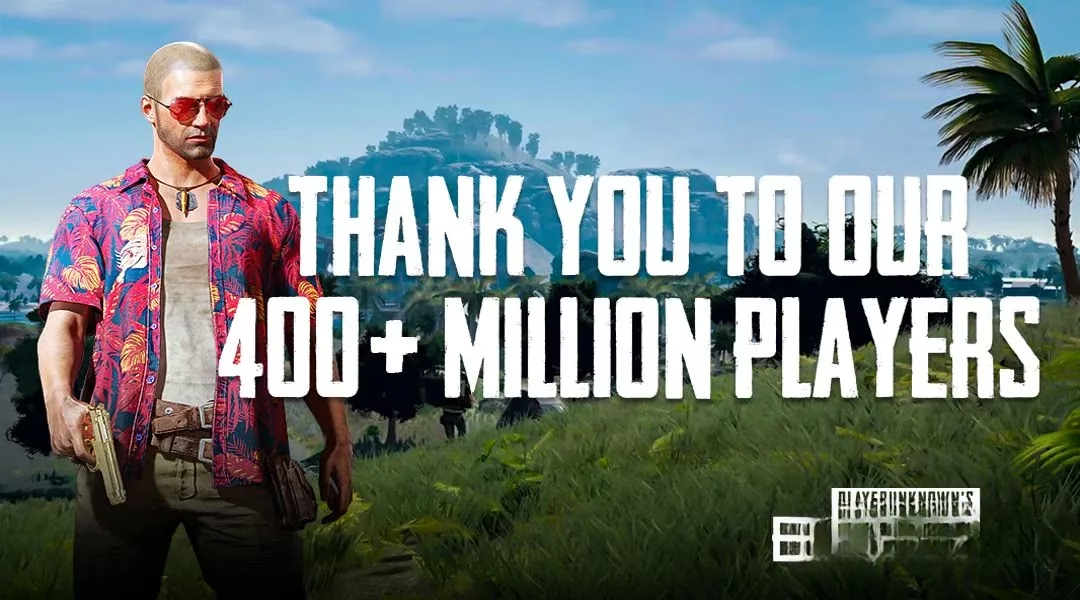
The numbers themselves read like epic verse from a digital age. PUBG Corp.'s announcement of surpassing 400 million registered players across PC, Xbox, and mobile platforms is a figure that bends the mind. Yet, the true pulse of this living world is found in its daily heartbeat: 87 million active players engaging in the tense ballet of survival each day. To grasp the scale, one might recall that World of Warcraft, after a decade, celebrated 100 million total accounts. PUBG now dances with nearly that number in a single, sunlit cycle. Can any other virtual world claim such a daily congregation of souls?
The statistics paint a portrait of layered success:
-
Total Registered Players: 400,000,000+ 🌍
-
Daily Active Players: 87,000,000+ ⚡
-
Copies Sold (PC/Console): 50,000,000+ 💿
This last figure, 50 million copies sold, sits in fascinating contrast to the oceanic swell of registered users. It whispers the tale of a dual existence: a premium experience on traditional platforms and a tidal wave of engagement on mobile, where free-to-play models have democratized access to the battlegrounds. This duality is the engine of modern gaming empires, where accessibility fuels community, and community becomes legend.
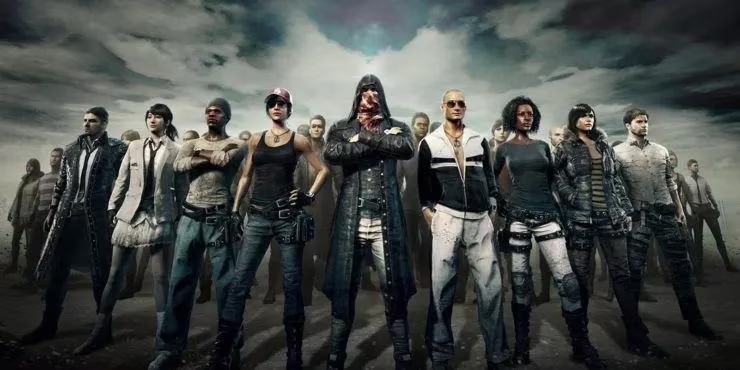
Whispers of decline have often circled like vultures, yet they consistently scatter before the undeniable data. Reports of a fading player base are but mirages on the Erangel horizon. The game's "peak" may be a point on a chart, but its plateau is a towering mesa visible from every corner of the gaming world. The success pioneered by PUBG, later mirrored and multiplied by others like Fortnite, redefined the very vocabulary of victory in the industry. These are not just player counts; they are populations, digital nations whose economies and cultures thrive in real-time.
Where does this enduring appeal reside? Perhaps in the game's core, unadorned poetry. Each match is a blank page:
-
The Descent: A silent flight over an uncertain landscape, the first choice of where to begin the story.
-
The Scramble: A frantic sonnet of looting, where fortune favors the bold and the strategic.
-
The Convergence: The slow, tightening rhythm as the play zone contracts, forcing encounters, weaving individual threads into a single, bloody tapestry.
-
The Climax: A final, breathless stanza where a single mistake or moment of brilliance crowns the victor.
This structure is a perfect, repeatable dramatic arc, different every time, powered by human unpredictability. It is a canvas for personal heroism, tragic missteps, and hilarious misfortune. Is it any wonder millions return daily to author their own tales?
The financial symphony playing behind this spectacle is as impressive as the gameplay. With a majority of players now engaging on mobile—a realm known for its potent profitability—the economic engine of PUBG hums with ever-greater efficiency. The initial 33% discount celebration for the PC version, a nod to its legacy, was but a single note in an ongoing opus of revenue. The game has seamlessly transitioned from a breakout hit to a sustainable pillar, funding continuous evolution through seasons, maps, and collaborations.
As we look upon the battlegrounds in 2026, we see not a relic, but a living monument. It stands as proof that a powerful, well-executed idea can achieve a form of digital immortality. PlayerUnknown's Battlegrounds taught a generation of players the language of the Battle Royale, the tense grammar of survival, and the euphoric punctuation of a "Chicken Dinner." Its maps—Erangel, Miramar, Sanhok—are not just arenas; they are mythic locations in video game history. The sound of footsteps on wood, the crack of a Kar98k, the anxious crawl through grass in the final circle—these are sensory poems memorized by 400 million souls.
In the end, PUBG's legacy is measured in more than billions of matches played or terabytes of data transferred. It is measured in the collective heartbeat of 87 million daily adventurers, all seeking their moment of glory in a beautifully hostile, endlessly renewable world. The game did not just capture a market; it captured an imagination, and that, perhaps, is the most poetic victory of all.