
Tencent gaming investments shape industry giants like Riot Games and Epic, influencing MOBAs, battle royales, and RPG studios globally.
Hey everyone! Let's talk about the 800-pound gorilla in the gaming room. As we're cruising through 2026, it's almost impossible to play a major game without somehow bumping into Tencent's influence. Think about it: from the MOBAs you rage-quit to the battle royales you drop into, chances are this Chinese tech giant has a finger in the pie. But with over 600 investments, who can keep track? Don't worry, I've dug through the latest info to break down exactly which of your favorite studios Tencent owns a piece of, and what that really means for the games you love.
The Crown Jewels: Riot & Epic
Let's start with the big ones. Back in 2011, Tencent made what might be the smartest move in gaming history: buying a 93% stake in Riot Games, the creator of League of Legends. By 2015, they owned it outright. Was it worth it? Uh, YES. LoL isn't just a game; it's a global esports phenomenon and a money-printing machine. The relationship wasn't always smooth sailing, though. Remember when Tencent wanted a mobile LoL and Riot said no? Tencent just went ahead and made Arena of Valor themselves! Talk about awkward family drama. Thankfully, they've mostly made up since Riot launched Wild Rift.
Then there's Epic Games. Tencent's $330 million investment in 2012 didn't just buy a stake; it arguably changed the entire industry. This partnership helped Epic shift to the free-to-play, games-as-a-service model we know today. The result? They scrapped Unreal Engine's subscription fee, opening the door for countless indie devs. Oh, and they also accidentally created a little game called Fortnite, which has earned over $20 billion. No big deal, right? Tencent's investment here was less about control and more about learning the live-service ropes—a lesson that paid off beyond anyone's wildest dreams.
The RPG Powerhouses: Larian & FromSoftware
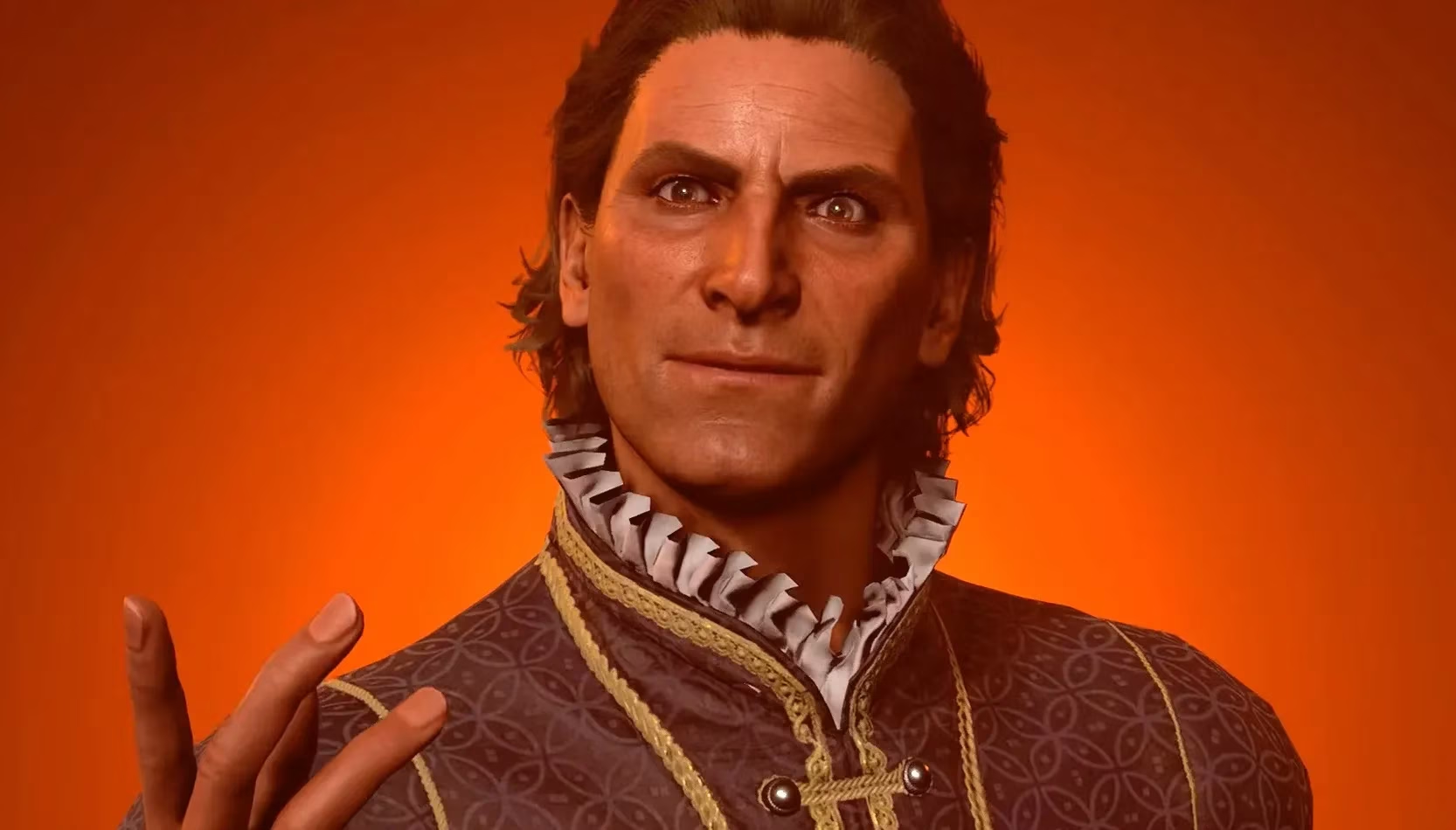
Baldur's Gate 3 swept the awards in 2023, but did you know Tencent owns 30% of Larian Studios? Before you panic, there's a crucial detail: these are "preference" shares. That means Tencent gets a financial cut from Larian's massive success, but CEO Swen Vincke and his wife retain all voting rights. Tencent has no say in whether we get a Baldur's Gate 4 or a game about space hamsters. It's a pure financial investment, letting the creative minds stay in charge.
The situation with FromSoftware (the geniuses behind Elden Ring and Dark Souls) is different. A Tencent subsidiary owns just over 16% as of 2022, with Sony holding another 14%. The goal was to help FromSoft expand its own global publishing. But here in 2026, the waters are murky. Rumors are swirling that Sony might try to buy the studio outright. Could Tencent's stake be a bargaining chip in a much bigger console war play? Only time will tell.
Battle Royale Buddies & The PUBG Situation
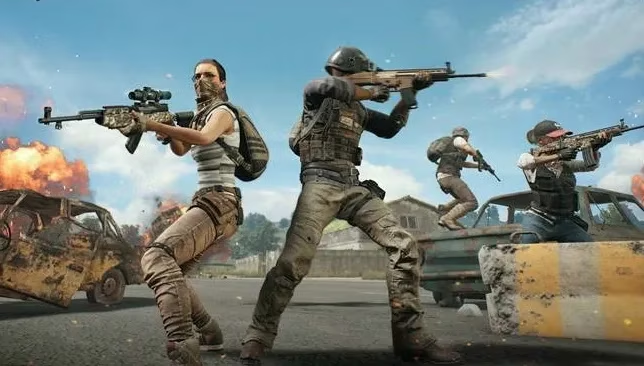
It's almost funny. Tencent owns pieces of both Fortnite (via Epic) and PUBG. It's like owning both Coke and Pepsi. Even wilder? Tencent has the publishing rights for both games in China. They're literally competing with themselves! Their investment in PUBG's developer, Bluehole, started in 2017 and is rumored to be around 10%. There was talk of a full buyout, but now Tencent seems content with its stake in Krafton, Bluehole's parent company.
The Rescuer: Ubisoft & Activision Blizzard
Tencent has played the white knight more than once. In 2018, they helped Ubisoft fend off a hostile takeover from Vivendi by buying a 5% stake. By 2022, they increased it to 11%. But here's the key: they entered a pact with the Guillemot family (Ubisoft's founders). Tencent is a silent partner with limited voting rights, making a takeover impossible. The deal also lets Tencent publish Ubisoft games in China, though that comes with its own controversies around censorship.
Years earlier, they did something similar for Activision Blizzard, buying 5% in 2013 to help it break free from Vivendi's control. It shows a pattern: Tencent often steps in as a stabilizing financial force, not necessarily a controlling one.
The Growing Portfolio: From Path of Exile to Remedy
Here’s a quick rundown of other major players in Tencent's stable as of 2026:
-
Grinding Gear Games (Path of Exile): Tencent bought a majority stake in 2018. Fans feared the worst for the game's economy, but so far, the developer has maintained its independence, and the game's core hasn't been "monetized" into oblivion.
-
Remedy (Control, Alan Wake): Tencent's stake grew from 3.8% in 2021 to 14% in 2024. They also have a $17 million loan agreement with the studio, convertible to shares in 2027. A strategic partnership for future story-driven games?
-
Supercell (Clash of Clans): An 84.3% stake acquired for a staggering $8.6 billion. A mobile gaming megadeal that makes perfect sense for Tencent's portfolio.
-
Fatshark (Warhammer: Vermintide, Darktide): Tencent acquired a majority stake in 2021, backing the co-op shooter specialists.
-
Funcom (Conan Exiles): Fully owned by Tencent since 2020, giving the survival game studio solid backing.
The Political Elephant in the Room
We can't ignore the geopolitical context. With the political climate in 2026, Tencent's vast U.S. and European holdings are under more scrutiny than ever. Remember the executive orders from a few years back? There's constant debate in government circles about whether to force Tencent to divest some of its game holdings. This shadow of uncertainty is the biggest wildcard for the future of all these studios.
What Does It All Mean?
So, is Tencent a monolithic overlord controlling your games? Mostly, no. Their strategy often looks like this:
-
Financial Backing, Not Creative Control: They frequently take non-voting or minority stakes (Larian, early Remedy).
-
Strategic Learning: Investments in companies like Epic were about understanding new business models.
-
Market Access: Owning stakes helps them secure publishing rights for the lucrative Chinese market.
-
Portfolio Diversification: They spread risk and opportunity across every genre and platform.
For most gamers, the day-to-day experience hasn't changed dramatically. Path of Exile still has its complex economy, League of Legends still gets its updates, and FromSoftware still makes brutally difficult games. Tencent's empire is built more on silent partnership and financial leverage than on direct intervention.
However, the layoffs at studios like Sharkmob in late 2024 are a reminder that when funding from a giant parent company dries up, the consequences are real. And as political tensions simmer, the stability of this entire web of investments is something to watch closely.
In the end, Tencent's gaming empire is a testament to the globalized, interconnected nature of modern gaming. It's less about a company owning your hobbies and more about a complex financial network that underpins a huge chunk of the industry. Whether that's a good or bad thing depends on your perspective, but one thing's for sure: in 2026, they're not going anywhere.