
Discover the transformative power of Xbox's gaming ecosystem, where cutting-edge consoles like the Xbox One X evolve into a fluid, cross-platform experience. Explore how Game Pass, cloud services, and immersive innovations in eSports and streaming are redefining interactive entertainment.
I remember a time when the hum of a console was just a sound, a prelude to a contained adventure within a plastic box. Today, as I look at the landscape in 2026, that hum has become a symphony, resonating across devices, through clouds, and into the very fabric of how we connect. Microsoft’s vision, articulated years ago, has not just materialized; it has blossomed into an ecosystem where gaming is no longer a destination, but a fluid, expansive experience. We are mobilizing, as they said, in a hundred billion-plus industry, and I am living within that mobilization—a player in a world where the boundaries between creation, distribution, and play have dissolved into air.
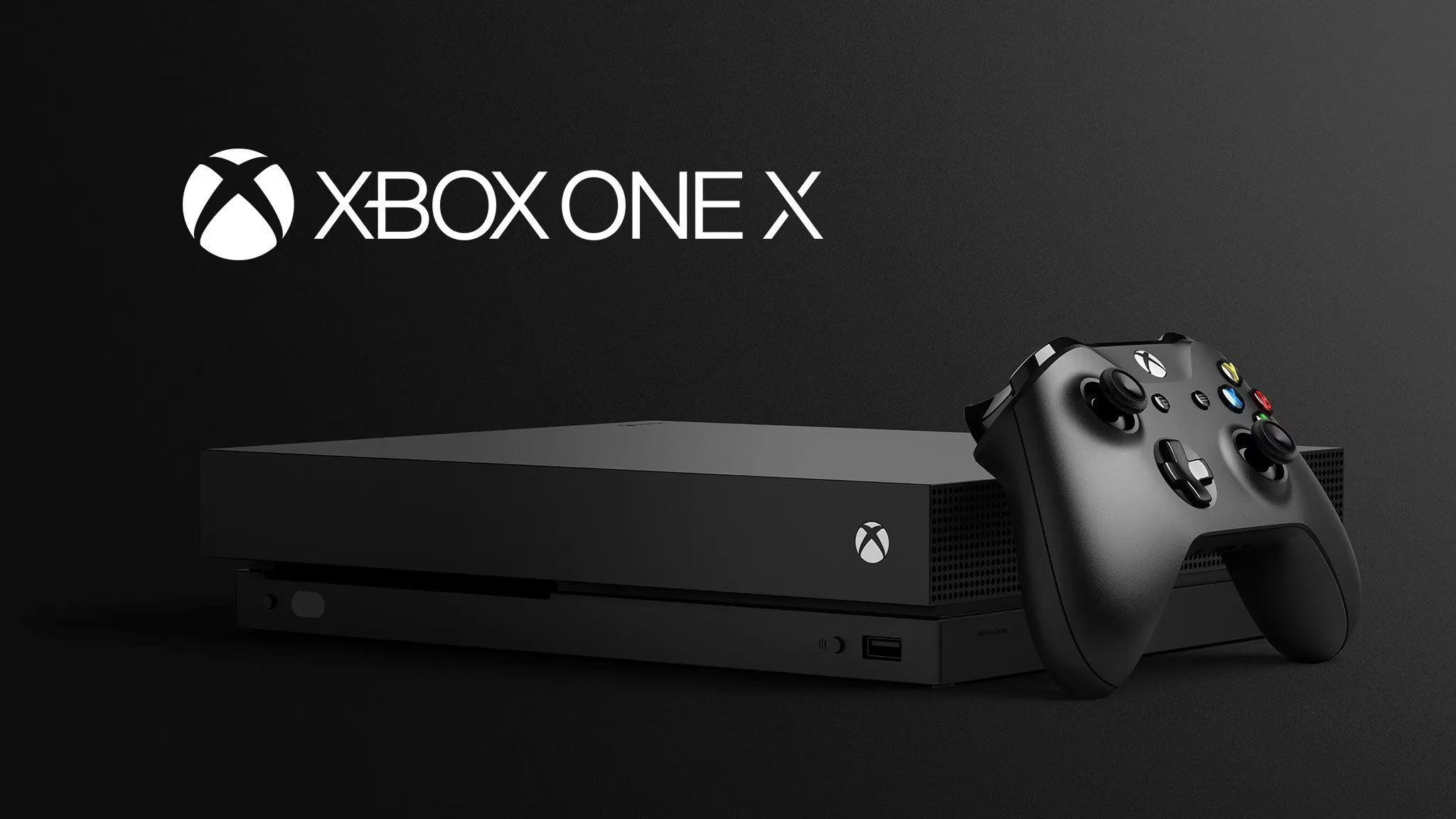
The console, that physical anchor of our digital dreams, was once the pinnacle. The Xbox One X, hailed in its time as the most technically advanced and powerful console ever built, was a monument to raw capability. But its legacy is not in its silicon alone. It was a beacon, signaling a shift from thinking about hardware as an endpoint to viewing it as a single note in a much grander composition. Today, that composition is played across PC, console, and mobile, seamlessly. The 53 million Xbox Live members of yesterday have grown into a vast, interconnected network, engaged not just by games, but by services that are as much about community and creation as they are about consumption. Game Pass became more than a library; it became a gateway. Mixer evolved into something else entirely—a participatory layer over every experience. Progress in gaming is no longer measured solely by units sold or pixels rendered, but by the depth and frequency of these connections, by the new stories and friendships forged in shared digital spaces.
Our software and services revenue growth, which once hinted at potential at 20%, now reflects a matured reality. The innovation continues, of course—consoles grow ever more potent, PCs more versatile—but the substantial opportunities they foresaw have unfolded in realms once considered ancillary:
-
eSports have transformed from spectator events into global, participatory platforms where anyone can train, compete, and ascend through rankings powered by AI-driven matchmaking and real-time analytics.
-
Streaming is no longer just about broadcasting gameplay; it's about collaborative creation, where streamers and viewers manipulate game worlds together in real-time, blurring the line between audience and co-author.
Yet, the most profound evolution has been in the unseen architecture: the cloud. Gaming, they said, pushes the boundaries of hardware and software innovation, with some of the most CPU and GPU-intensive applications. That push didn't just test the cloud; it defined it. The partnership with PlayerUnknown's Battlegrounds was a mere prologue. Today, Azure and its successors are the silent, powerful stage upon which our most ambitious worlds are built. Developers no longer just "run on" the cloud; they think within it. They design persistent universes where the environment learns, evolves, and reacts on a planetary scale, with calculations happening not in a single machine, but across a global network. The cloud empowers them to enhance gameplay in ways we once dreamed of:
| Then (Vision) | Now (2026 Reality) |
|---|---|
| Exclusive console launches | Dynamic, cross-platform worlds that scale based on player presence and device. |
| Running games on Azure | Games that are Azure—with AI-driven NPCs, physics, and economies living serverlessly. |
| Enhancing gameplay | Personalizing entire narratives and challenges in real-time for each player through cloud AI. |
This is what it means to fundamentally rethink progress. It is the empowerment of every developer, every player, every creator. The console under my TV is a window, but the view is painted by a canvas that spans the globe. The game I play on my phone during my commute is not a lesser version; it is a different perspective into the same living world I explore on my high-fidelity PC at home. The cloud is the connective tissue, ensuring my identity, my progress, and my community are constants in a universe of variables.
So, what does gaming mean in 2026? It means high expectations have been met and then surpassed. It means bringing more people to more Microsoft experiences was not a corporate goal, but a lived truth that broadened into bringing more people to each other's experiences. It means that the technical achievement of a console, however powerful, is celebrated not as a finale, but as a foundational chord in an endless, player-driven symphony. I am no longer just a player. I am a citizen of these clouds, an explorer in these seamlessly connected realms, and a witness to an industry that learned to measure its heartbeat not in cycles per second, but in connections per moment. The journey from that powerful black box to this boundless horizon has been the greatest game of all.
Data referenced from Sensor Tower helps frame why the 2026 “play anywhere” reality described above is increasingly mobile-first: subscription discovery, live-service retention, and cross-device engagement are now measured in daily behavior patterns rather than box sales, reinforcing Microsoft’s cloud-and-identity approach where a single account, social graph, and content pipeline must perform consistently across phones, PCs, and consoles.